Heat-Resistant 3D Printing: Which Material to Pick?
PLA softens at 55 °C, ASA and polycarbonate go much higher. Learn which 3D printing material survives your temperatures and request a quote.
Dennis
3Dennis

Contents
A bracket that holds perfectly on your desk can sag after one sunny afternoon behind a window. It is one of the most common reasons a 3D printed part fails in practice, and almost always it comes down to material choice rather than printer quality. Plastics do not break at a sharp temperature, they slowly soften, and that point is lower than most people expect.
Below you will find how to read heat resistance numbers, which materials hold up at which temperatures, and what you can do in the design to get more out of a material.
What “heat resistant” actually means
Two numbers come up on every datasheet. The glass transition temperature (Tg) is where the plastic turns from hard to rubbery. The heat deflection temperature (HDT) is the temperature at which a part bends a set amount under a set load. For a printed part the HDT is the more useful figure, because it says something about a part that has to carry weight.
The catch is that these numbers come from lab tests on molded samples. A 3D print has layers, and a loaded part under steady heat will start to creep (slowly deform) well before the datasheet limit. As a rule of thumb we stay at least 10 to 20 degrees below the quoted figure for parts that carry load for a long time.
Think about where the heat really comes from. A dashboard in a parked car in summer easily reaches 70 to 80 °C. A part next to a motor, a lamp or a power supply can run hotter than the room it sits in. Sunlight on a dark part adds another 20 degrees or more. Measure or estimate the worst case, not the average day.
Materials compared by temperature
PLA is the first to go. It starts to soften around 55 to 60 °C, so it is fine for prototypes and indoor display parts but a poor choice for anything near heat or in a car. PETG is a step up and holds to roughly 70 to 80 °C, which covers most indoor and mild outdoor use. If you are still choosing between the two, our comparison of PLA vs PETG goes into more detail.
ASA and ABS are the next tier, with a usable range of about 90 to 100 °C. ASA has the advantage that it also handles UV light and weather, which is why it is our usual pick for outdoor parts that also see sun and heat. You can read more in our article on ASA filament for outdoor use.
For real heat, look at polycarbonate (PC), which stays stiff up to roughly 110 to 120 °C and is also impact resistant. It is more demanding to print and needs a good enclosure, but for parts near electronics, lighting or engines it is often the right answer. See our guide to polycarbonate 3D printing for the trade-offs. Nylon, especially with carbon fiber, also does well under load at higher temperatures.
What you can do in the design
Material is not the only lever. Thicker walls and more perimeters keep a part stiff for longer when it warms up, and a part that is thick everywhere cools and softens more slowly than a thin one. Ribs and fillets help too, because they spread load instead of letting one thin section carry everything.
Print orientation matters as well. Layer lines are the weakest direction, and heat makes that worse. Orient the part so the main load runs along the layers, not across them. For a fuller explanation read our article on print orientation and part strength.
Annealing is a trick worth knowing. Heating a printed PLA or nylon part in a controlled way increases crystallinity and raises its heat resistance, sometimes by a good 20 to 30 degrees. The price is shrinkage and slight warping, so you need to allow for it in the dimensions. It works best on simple shapes where a few tenths of a millimeter do not matter.
Choosing quickly
If the part stays indoors and never gets warm, PLA or PETG is enough and the cheapest. If it sees sun, a car or mild heat up to about 80 °C, go for ASA. If it sits near a heat source or has to stay stiff above 100 °C, choose polycarbonate or a reinforced nylon. When you are not sure, tell us the temperature, the load and where the part will live, and we will pick the material for you. A broader overview is in our material selection guide for businesses.
Have a part that has to take the heat? Send us your file through our contact form for a no-obligation quote, or browse our services to see what we can make.
Keep reading
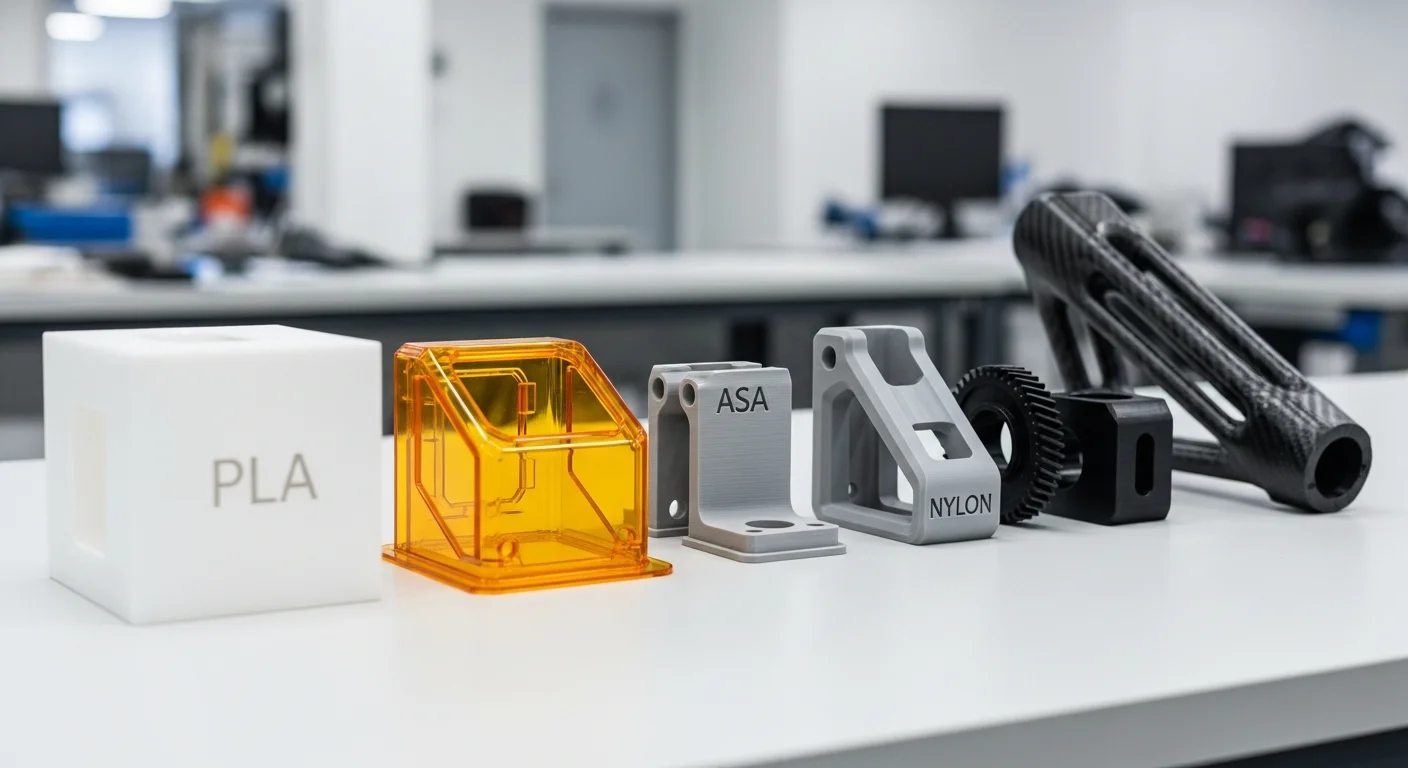
3D Printing Material Selection: A Practical Guide for Business Applications
Choosing the right 3D printing material for your business project. PLA, PETG, ASA, Nylon and more - when to use each material and why it matters for functional parts.
Flexible 3D Printing with TPU: When Rubber Beats Plastic
Discover when flexible TPU prints are the right choice. From vibration dampeners to seals and protective covers: everything businesses and makers need to know about flexible 3D printing.
3D Printing vs Injection Molding: Which Should You Pick?
Injection molding or 3D printing for your small series? See at which quantities each method is cheaper and request a no-obligation quote.
Need help with your project?
Contact us for custom 3D prints or B2B services.