ASA Filament: The Best Choice for Durable Outdoor Parts
ASA filament is UV-resistant, weather-resistant, and stronger than PETG for outdoor use. Find out when to choose ASA for your 3D printed outdoor components.
Dennis
3Dennis
Contents
The sun is the biggest enemy of most 3D printing materials. PLA discolours and becomes brittle after a few weeks outdoors. ABS has similar problems and is also difficult to print. PETG lasts longer, but also has its limits. ASA is the material you want for long-term outdoor applications.
In this article, we explain what ASA filament is, when to choose it over alternatives, and which applications benefit most.
What is ASA filament?
ASA stands for Acrylonitrile Styrene Acrylate. It is a technical polymer closely related to ABS, but developed to correct ABS’s biggest weakness: sensitivity to UV light and moisture.
Where ABS loses its colour, warps, and degrades after a few months outdoors, ASA retains its mechanical properties and colour stability for years. This makes it ideal for anything that stays outside permanently or long-term.
The material properties are impressive:
- UV resistance: retains colour and strength after prolonged exposure
- Weather resistance: handles rain, frost, and heat
- Tensile strength: comparable to ABS, stronger than PETG
- Rigidity: less flex than PETG, suitable for structural applications
- Temperature resistance: up to 95-100°C, higher than PETG
ASA vs PETG vs ABS: when to choose which?
We regularly hear from customers who ask us for outdoor components: “Isn’t PETG good enough?” Sometimes it is, but it depends on the application.
When PETG is sufficient
PETG is an excellent choice if your parts are only occasionally outdoors, or in a sheltered outdoor environment (under a canopy, not in direct sun). For standard outdoor use with limited sun exposure, PETG is cheaper and easier to print than ASA.
When ASA is the better choice
Choose ASA as soon as any of these conditions apply:
- The part is in direct sunlight (no shade, no protection)
- You expect a lifespan of several years outdoors
- The part carries mechanical loads combined with weather exposure
- Colour stability matters (no yellowing or discolouration acceptable)
- The environment has large temperature swings, like a metal enclosure that heats up significantly in summer
ABS: not really an outdoor option
ABS is sometimes marketed as “weather-resistant”, but in practice it performs poorly outdoors. It has poor UV resistance, requires a demanding print environment (enclosed printer necessary), and produces inconsistent results compared to ASA. We rarely recommend ABS for outdoor use.
Applications where ASA excels
Electronics and sensor enclosures
Think weather station housings, outdoor RFID readers, smart doorbell systems, or solar panel monitoring units. These parts need to function reliably for years without colour change or shrinkage that could compromise seals.
Automotive and vehicle applications
ASA is standard in the automotive industry, partly due to its UV resistance. 3D printed ASA parts are used for mirror brackets, grille inserts, antenna bases, and licence plate holders.
Garden and outdoor installations
From hose holders to bird feeders, from sprinkler heads to tool holders. ASA still looks and performs like new after years of outdoor exposure.
Architectural marking and signage
Building numbers, letterbox nameplates, temporary signage on construction sites. The material keeps text sharp and readable over time.
Marine applications
Salt air and moisture are aggressive. ASA holds up well in marine environments, making it suitable for boat parts, marina signage, and coastal monitoring stations.
Printability: what you need to know
ASA is slightly more challenging to print than PETG, but at a professional print service this is not a problem. The challenges are:
Warping risk: Like ABS, ASA tends to warp with poor temperature control. An enclosed printer with stable ambient temperature is necessary.
Fumes: ASA releases more fumes during printing than PETG. Professional printers have ventilation and filtration for this material.
Temperatures: Print nozzle around 240-260°C, heated bed at 90-110°C. Not every consumer printer can reach these specs.
This is precisely why businesses choose a professional 3D print service for ASA parts: the material requires experience and the right equipment.
Colour options with ASA
A key advantage of ASA for outdoor use is that colours remain stable. Other materials yellow or fade, but ASA holds its original colour. This matters most for:
- House numbers and nameplates (readability)
- Corporate logos and outdoor branding
- Colour-coding of infrastructure (cables, pipes, junctions)
We print ASA in black, white, grey, red, blue, and other standard colours. Have a specific colour requirement? Ask us about the options.
Cost: ASA vs other materials
ASA costs more than PLA or PETG, but it is an investment that pays off. A part that lasts three years outdoors is cheaper than replacing a PLA part every year, especially when you factor in the labour cost of replacing it.
The premium over PETG is typically 15-25% per part. For most outdoor applications, this is more than justified by the longer service life.
Designing for ASA outdoor use
Good design makes the difference, even with the best material. Consider:
- Drainage: ensure water cannot pool in hollow spaces, which promotes algae growth and temperature stress
- Screw connections: use guide holes and metal inserts for threads in parts that are regularly disassembled
- Wall thickness: minimum 2mm for outdoor parts, minimum 3-4mm under load
- Finishing: want an extra protective layer? A coat of UV-resistant lacquer can double the service life further
Also read our guide on designing for 3D printing for general design tips.
Getting ASA parts printed at 3Dennis
We print ASA parts daily for companies in industry, construction, agriculture, and automotive. From prototypes to small series. Typical lead time is 2-4 business days after your file is approved.
Send us your design and we will work out the best approach together. No final CAD file yet? We are happy to help in the design phase too.
Summer is the moment to tackle outdoor projects. Make sure your parts still perform next year.
Keep reading
PLA vs PETG: Which Material Should You Choose for Your 3D Print?
PLA or PETG for your 3D print project? Discover the differences in strength, temperature resistance, printability and cost. A practical comparison for hobbyists and businesses alike.
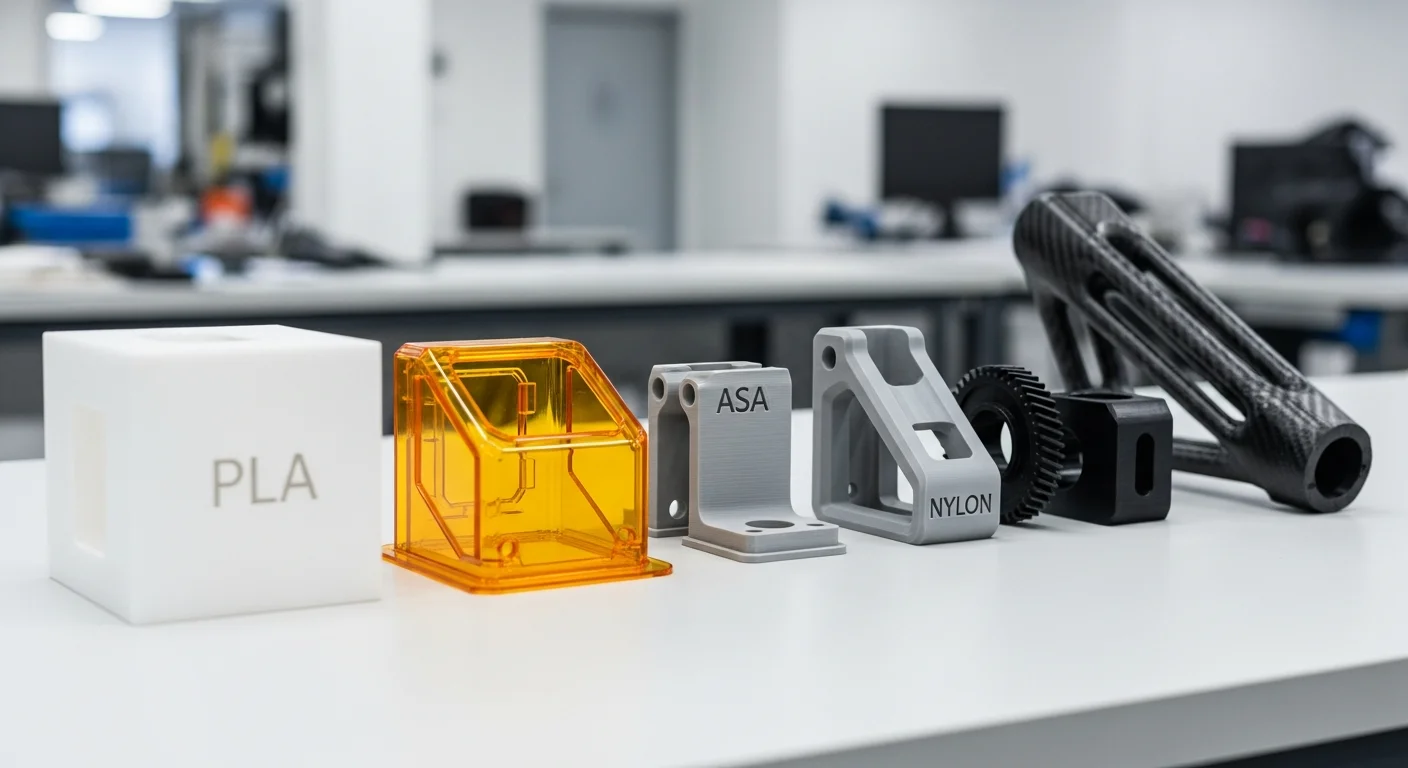
3D Printing Material Selection: A Practical Guide for Business Applications
Choosing the right 3D printing material for your business project. PLA, PETG, ASA, Nylon and more - when to use each material and why it matters for functional parts.
PETG for Outdoor Use: Everything You Need to Know
Is PETG suitable for outdoor applications? Learn about UV resistance, weatherproofing, and why PETG is our go-to material for outdoor 3D printed parts.
Need help with your project?
Contact us for custom 3D prints or B2B services.