3D Printing Tolerances and Accuracy: What to Expect
How accurate is FDM 3D printing? Learn typical tolerances, factors affecting precision, and how to design parts for the best possible fit.
Dennis
3Dennis
Contents
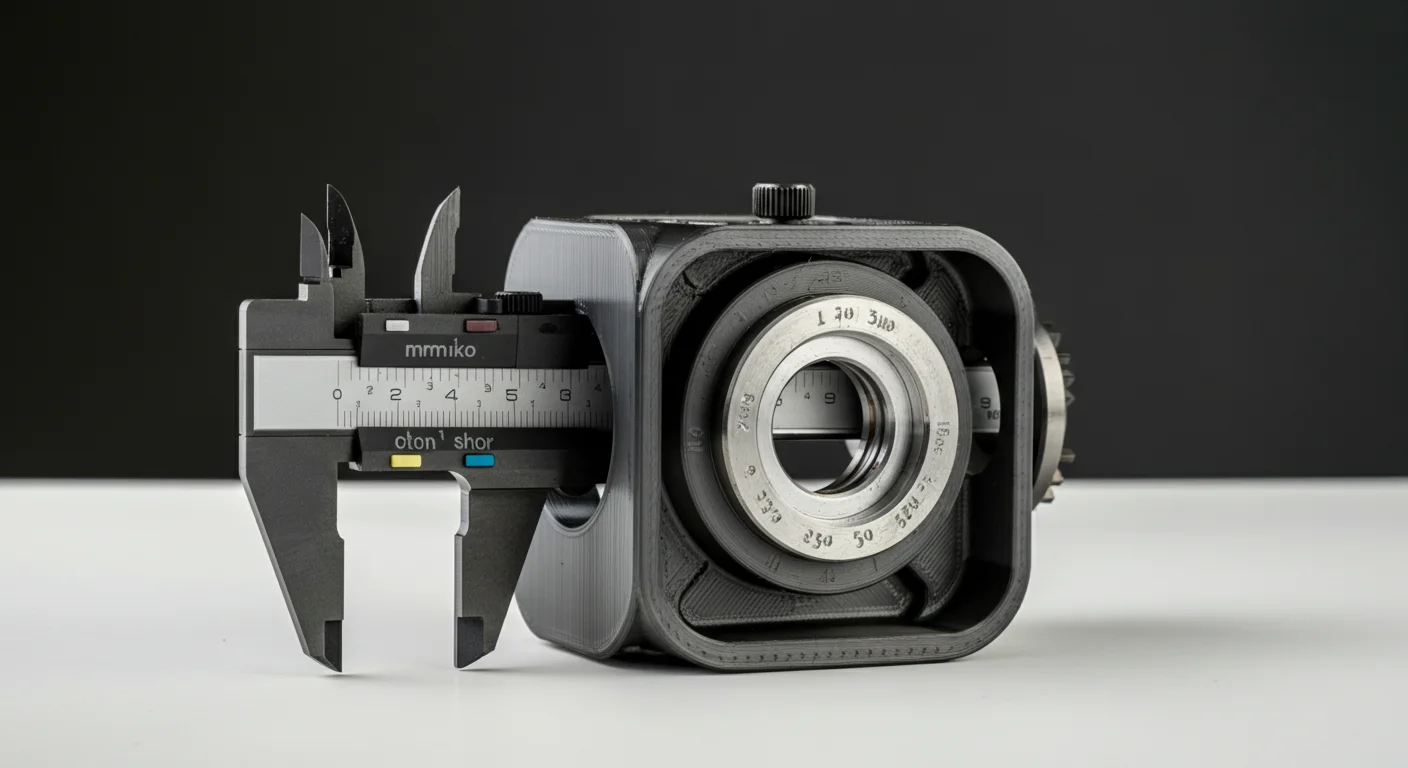
One of the most common questions from engineers and product designers is: how accurate is a 3D print? The answer depends on several factors, but with the right knowledge you can design parts that fit, function and look professional.
What are tolerances in 3D printing?
Tolerances define how much a printed dimension may deviate from the theoretical size in your design. If you design a part with a 10.00 mm hole, the printed result might be 9.85 mm or 10.15 mm. That deviation of ±0.15 mm is the tolerance.
With FDM (Fused Deposition Modeling) — the technology used at 3Dennis — typical tolerances are:
- Dimensional accuracy: ±0.2 to ±0.5 mm for most dimensions
- Smallest detail: approx. 0.4 mm (equal to the nozzle diameter)
- Layer thickness: 0.1 to 0.3 mm (depending on quality settings)
This may sound wide, but for most applications — from product holders and enclosures to jigs and functional prototypes — this is more than sufficient.
Factors that influence precision
Material
Every material has its own shrinkage and expansion behaviour. PLA is the most dimensionally stable; it shrinks little and is predictable. PETG shrinks slightly more but is more flexible and tougher. ABS shrinks the most and requires an enclosed printer for good results.
Keep in mind that the final size of a print always depends on the material used. At 3Dennis we account for this with every order.
Layer direction (Z-axis)
In the Z-direction (vertical), dimensions sometimes deviate slightly more than in the X and Y directions. This is because layer height determines the Z step size. X and Y dimensions are generally slightly more accurate because the print heads move continuously.
Design
The orientation of the part on the print bed has a major impact. A cylinder printed upright is more accurate than one lying horizontally (due to the stepped approximation of round shapes in layers).
Machine and calibration
A well-calibrated printer makes a big difference. At 3Dennis we use professional machines that are regularly checked for dimensional accuracy.
When is FDM accurate enough?
FDM is well-suited for:
- Functional prototypes where dimensional stability is more important than aesthetics
- Enclosures and clips that need to fit standard hardware
- Jigs and fixtures for production and assembly — see also our article on manufacturing tools
- Spare parts that replace an existing component
FDM is less suitable when you need tolerances below 0.1 mm, or for moving parts that require precision-machined bearing seats. In those cases you can consider post-machining critical surfaces, or choosing resin printing, which offers higher precision but lower strength.
Design tips for better fit
Holes and pins
FDM prints holes systematically slightly too small. If you want to pass an M5 bolt through a hole, design the hole at 5.3 to 5.5 mm instead of exactly 5.0 mm. For press fits, an oversize of 0.1 to 0.2 mm is a starting point — always test with a prototype.
Moving parts
For hinges, slides or other moving parts, a clearance of 0.3 to 0.5 mm on each side is usually sufficient to prevent friction.
Walls
Minimum wall thickness is 1.2 mm (3 × nozzle diameter at 0.4 mm nozzle). Thinner walls can bow, vibrate or break during printing.
Bridge with testing
Have critical interfaces? Print a test piece first: a small part with only the critical geometry, so you can verify the fit before printing the full part. This saves material and time.
How 3Dennis ensures quality
At 3Dennis we check every part before shipping. Critical dimensions are measured manually when in doubt, and we use fixed profiles per material type so calibration is consistent. Have specific tolerance requirements? Include them with your order and we will take extra care.
Browse our full material range on the products page or read more about designing parts for 3D printing for further design guidelines.
Ready to have your part printed?
Upload your 3D model and specify which tolerances matter. We are happy to advise on material, orientation and post-processing to achieve the best result. Get in touch or upload directly via the website.
Keep reading
3D Printing File Formats: STL, STEP or 3MF Explained
STL, STEP, 3MF or OBJ: which file should you send for a 3D print? Learn the differences, common export mistakes, and how to get an accurate quote fast.
Threaded Inserts in 3D Prints: Professional Strength Connections
Learn how brass heat-set inserts transform your 3D printed parts into professional-grade components with durable, reusable threaded connections.

3D Printed Scale Models: Professional Architectural Models on Demand
Discover how 3D printing helps architects and designers create detailed scale models quickly and affordably. From concept to physical model in just a few days.
Need help with your project?
Contact us for custom 3D prints or B2B services.