Threaded Inserts in 3D Prints: Professional Strength Connections
Learn how brass heat-set inserts transform your 3D printed parts into professional-grade components with durable, reusable threaded connections.
Dennis
3Dennis
Contents
3D printed parts are strong, lightweight, and cost-effective to produce. But they’ve always had one persistent weakness: screw connections. Threading directly into plastic works once or twice, then strips out. The solution is brass heat-set inserts.
At 3Dennis, we incorporate these inserts as standard practice for parts that require repeated disassembly or mechanical loading. Here’s how they work, when you need them, and what they mean for your project.
Why Direct Threading in Plastic Fails
When you thread a screw directly into PLA or PETG, you’re cutting threads through the material. This works for a one-time connection, but has serious limitations:
- Stripping out: After 5-10 disassembly cycles, the threads are gone
- Limited pull strength: Plastic threads can’t hold significant loads
- No reworkability: Once stripped, the connection is lost
- Vibration sensitivity: Plastic threads loosen over time under vibration
For a prototype or hobby project, this is sometimes acceptable. For a functional end product or a part that gets opened regularly, it’s a dealbreaker.
The Solution: Brass Heat-Set Inserts
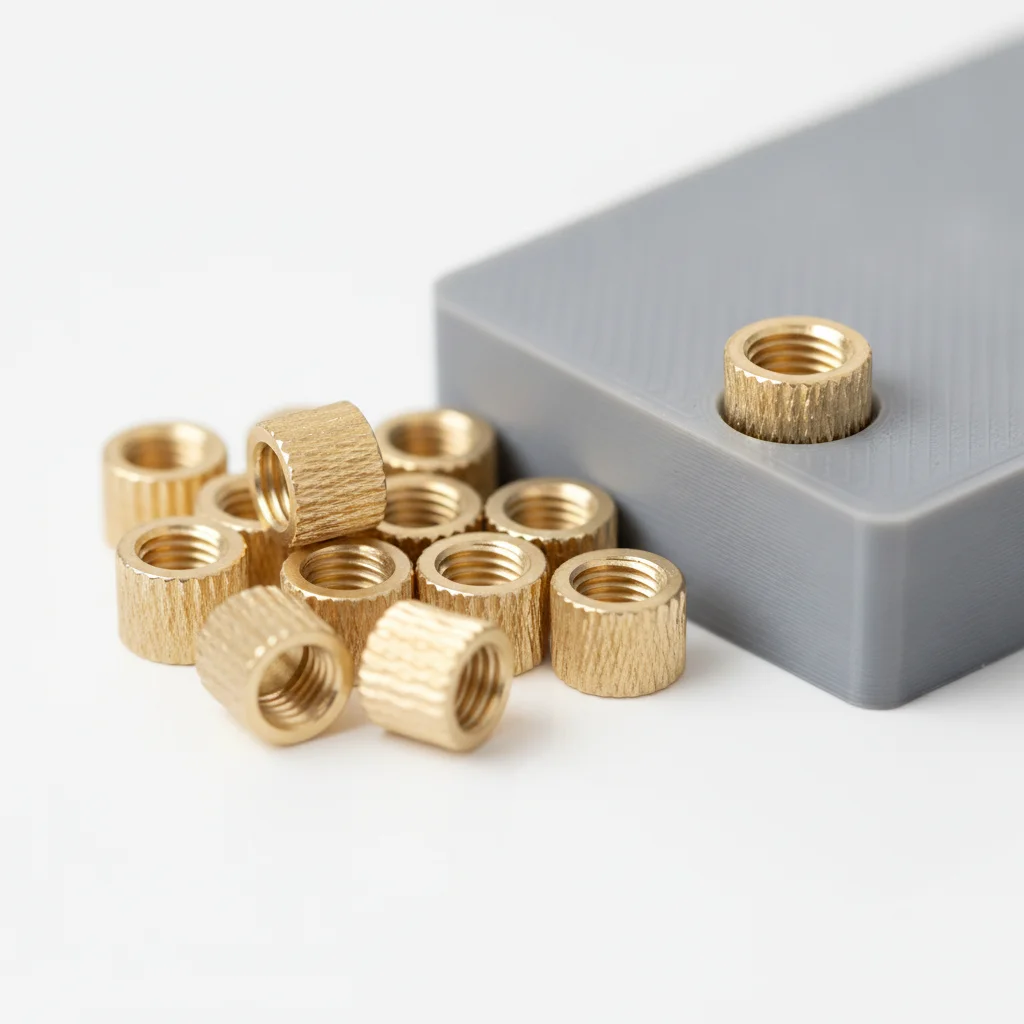
Heat-set inserts (also called threaded inserts or brass inserts) are small brass cylinders with a metric female thread on the inside. They’re heated with a soldering iron or specialized tool and then pressed into a pre-printed hole in the part.
The brass melts the surrounding plastic, which then solidifies around it when it cools. Result: a metal thread permanently embedded in your 3D print.
Key Advantages
Durable connection: Brass is significantly stronger than PLA or PETG. The threads don’t strip, even with frequent use.
Fully reusable: You can thread the same screw in and out dozens of times without any degradation. Ideal for service panels, enclosures, and parts that open regularly.
Professional finish: Products with proper metal threads feel solid and well-engineered.
Standard metric compatibility: M2, M2.5, M3, M4, and M5 are the most common sizes. The choice depends on the load requirements and available space.
Which Materials Work Best?
Heat-set inserts work with most thermoplastics, but some combinations are better than others.
PLA: Works well, easy to process. Less suitable for heat or heavy mechanical loading.
PETG: Our recommendation for most applications. Combines well with inserts, tough enough for most functions, and resistant to mild chemicals.
ABS/ASA: Excellent for inserts due to the higher glass transition temperature. Ideal for applications in warmer environments.
Nylon: Top choice for heavily loaded connections. The combination of nylon flexibility and brass rigidity gives excellent results.
TPU: Works, but requires careful placement due to the soft properties. Suitable for enclosures that allow slight flex.
Real-World Applications
Electronics Enclosures
Enclosures for PCBs, controllers, sensors: classic candidates for heat-set inserts. The lid gets opened multiple times for programming, maintenance, or updates. With inserts, this can happen dozens of times without any wear.
Prototyping and Product Development
During development, a part gets regularly disassembled, modified, and reassembled. Heat-set inserts make this process reliable and repeatable, so your test results aren’t affected by stripped-out threads.
Industrial and Mechanical Components
Mounting brackets, motor covers, sensor housings: parts that need to withstand vibration and loading. Brass inserts provide the grip that plastic alone cannot.
Consumer Products
From custom gadgets to kitchen accessories: if you’re selling a product that can be opened or serviced, inserts are the professional choice.
How We Handle It at 3Dennis
When you submit a design that needs screw connections, we proactively advise on the use of inserts. We take care of:
- Correct hole geometry in the print design: Diameter and depth are tuned to the insert size, ensuring a perfect fit
- Adequate wall thickness around the insert: Enough material around the insert prevents cracking during installation
- Insert installation: We press the inserts in at our workshop, so your part arrives ready for assembly
Already have an existing design? We can advise on how to adapt it for inserts. Send us your design and we’ll give you feedback.
Insert Sizes and When to Choose Each
| Size | Use Case |
|---|---|
| M2 / M2.5 | Small electronics, compact enclosures |
| M3 | Most versatile, Arduino/Raspberry Pi mounting |
| M4 | Medium mechanical loading |
| M5 | Heavy-duty connections, industrial use |
For most projects, M3 is the default. Not sure? Just ask us.
Ready for Stronger Connections?
Heat-set inserts are one of those small details that make the difference between a hobby print and a professional end product. They’re affordable, straightforward to apply, and make your design significantly more robust.
Have a project where threaded inserts would be useful? Check out our services for more information, or contact us directly. We’re happy to advise on the right approach for your specific application.
Keep reading
Print Orientation in 3D Printing: How It Decides Part Strength
The same 3D printed part can be several times stronger or weaker depending on how it is oriented. Learn how layers work and request a quote for strong parts.
3D Printing Tolerances and Accuracy: What to Expect
How accurate is FDM 3D printing? Learn typical tolerances, factors affecting precision, and how to design parts for the best possible fit.
Is 3D Printed Plastic Food Safe? What You Need to Know
Can you use 3D printed parts around food? Learn why layer lines, additives and heat matter, which uses are fine and when to ask us for advice.
Need help with your project?
Contact us for custom 3D prints or B2B services.