3D Printing Costs Explained: What Determines the Price of Your Print?
What does 3D printing actually cost? Discover which factors determine the price: material, print time, complexity, post-processing, and more. With practical examples.
Dennis
3Dennis
Contents
“What does a 3D print cost?” is the question we get most often. The honest answer: it depends on several factors. But once you understand how the price is built up, you can make smarter choices and avoid unnecessary expense.
In this article we explain transparently what determines the cost of a 3D print. No vague answers, just concrete factors with real examples.
1. Material costs
The filament used directly affects the price.
PLA is the most affordable material and costs the least per gram. Ideal for prototypes, decorative objects, and functional parts without high demands.
PETG costs slightly more than PLA but offers better mechanical and chemical properties. The most common choice for professional applications.
ASA and ABS are more expensive than PETG and are used for outdoor applications or higher temperatures.
Nylon (PA12) is significantly more expensive, but indispensable for heavily loaded mechanical parts.
Specialty materials like carbon fibre composite or TPU (flexible) are the priciest, but offer unique properties.
As a rule of thumb: a 50g part in PLA costs a few cents to a euro in material. The same part in nylon costs five times more in material. Material choice has a big impact.
2. Print time
Print time is often the largest cost driver. An FDM printer runs at a fixed hourly rate for electricity, wear, and machine time. The longer the print, the higher the cost.
Print time is determined by:
Volume: More material means longer print time. A hollow enclosure prints faster than a solid block of the same outer dimensions.
Layer height: Fine printing (0.1 mm) takes two to three times longer than coarse printing (0.3 mm). For parts without high aesthetic requirements, coarser printing is a solid cost saving.
Infill percentage: 20% infill prints significantly faster than 80% infill. Unless you need high compressive strength, 20-40% is sufficient for most applications.
Wall count: Fewer walls means faster printing. We advise you during quoting which settings suit your application.
3. Design complexity
More complex models demand more from the printer and sometimes extra preparation time.
Supports: Overhangs beyond 45 degrees require support material that is removed after printing. This adds both material and post-processing costs.
Detail level: Small fine details require a finer nozzle and longer print time.
Multiple parts: An assembly of 5 components costs more than one part, but may be smarter due to printability or strength requirements.
Orientation: How the model sits on the build plate determines print time and strength distribution. We optimise this for you.
4. Post-processing
By default we deliver parts as they come off the printer: with the characteristic layer texture. Want more? Options include:
- Support removal: Included in the price for simple supports
- Sanding: Smoother surface, costs additional time
- Primer and painting: For a fully smooth, paint-ready surface
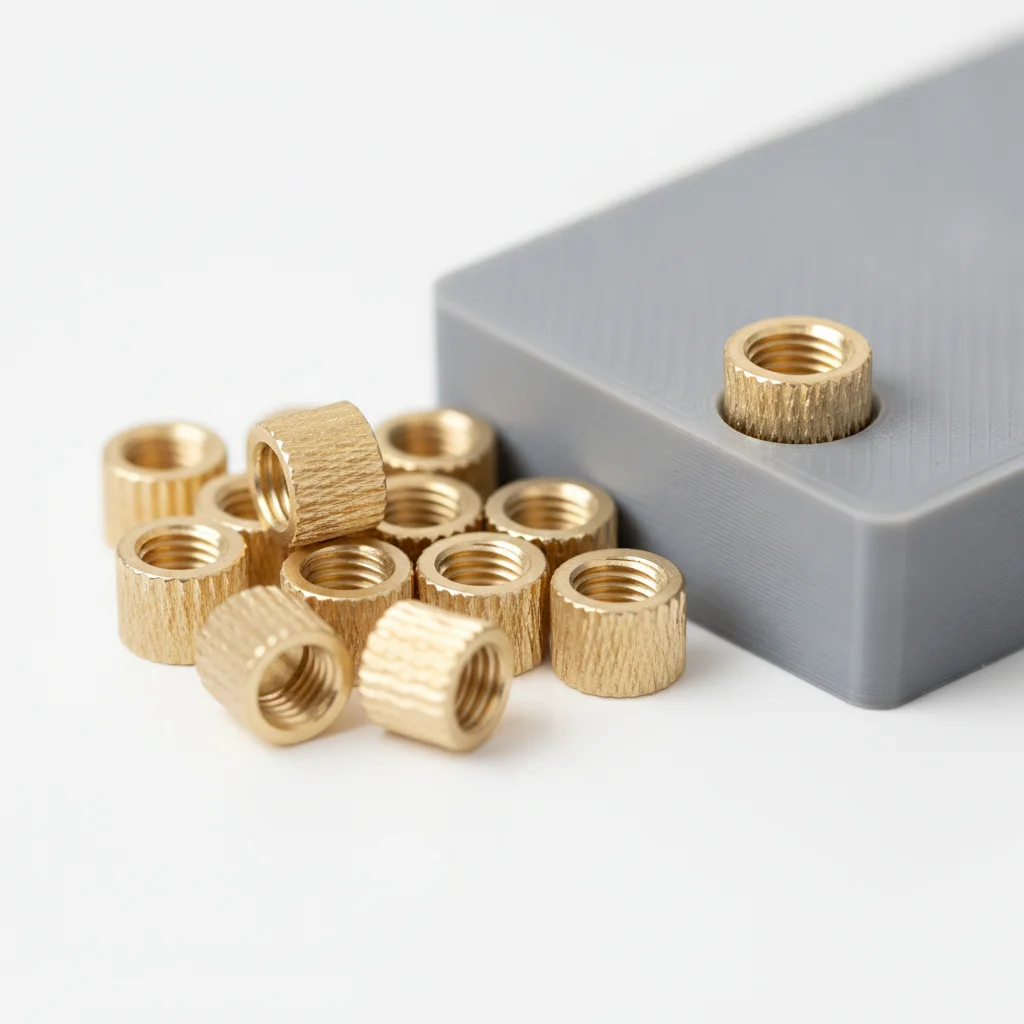
- Heat-set inserts: Brass inserts for threaded connections, pressed in at our workshop. Read more about threaded inserts
- Painting or spraying: On request, for a specific colour or finish
Post-processing can significantly increase the price, but is sometimes essential for the end result.
5. Quantity
3D printing is ideal for small runs because there are no tooling costs. But scale benefits apply here too:
- 1 piece: Full price per unit
- 5-10 pieces: We can use the build plate more efficiently, reducing price per unit
- 50+ pieces: Significantly lower price per unit through efficient use of print hours
Batch production is always more economical. Let us know in your request if you are considering more pieces.
What does a 3D print cost in practice?
To give you a feel:
| Part type | Material | Indicative price |
|---|---|---|
| Small clip or bracket | PETG | €5 - €15 |
| Medium-sized part | PETG | €15 - €50 |
| Large or complex part | PETG | €50 - €150 |
| Mechanically strong part | Nylon | €30 - €100+ |
| Technical prototype | PETG/ABS | €40 - €200 |
These are indicative prices. The actual price depends on all the factors above.
How to request a quote
For an accurate quote, we need:
- 3D file (STL, STEP or similar) — or photos and dimensions if you don’t have a file
- Material preference — or a description of the application
- Quality requirements — standard, fine, or post-processing desired?
- Quantity
- Desired delivery time
Send everything via our contact form. For simple parts we can usually give an indication the same day. Also check our services page for more information about what we offer.
Transparency is key at 3Dennis. You pay for what you get, and we always advise on how to save costs without compromising on quality.
Keep reading

3D Printing for Trade Shows and Events: Stand Out with Custom Parts
Discover how 3D printed displays, product models, and branded items help your trade show booth stand out. Practical guide for businesses attending fairs and events.
B2B 3D Printing: How Businesses Save Time and Money with Custom Parts
Discover how businesses save costs with 3D printed parts. From prototypes to production runs - the business benefits of 3D printing explained.
3D Printing vs Injection Molding: Which Should You Pick?
Injection molding or 3D printing for your small series? See at which quantities each method is cheaper and request a no-obligation quote.
Need help with your project?
Contact us for custom 3D prints or B2B services.