End-Use Production Parts: When 3D Printing Replaces Traditional Manufacturing
Discover how businesses use 3D printed end-use parts in production. From material advances to real cost benefits — why 3D printing is no longer just for prototypes.
Dennis
3Dennis
Contents
Beyond Prototyping: 3D Printing as a Production Method
For years, 3D printing was synonymous with prototyping. Engineers would print a rough model, check the fit, iterate, and then send the final design off to an injection molder or CNC shop for “real” production. That workflow made sense when printed materials were brittle, printers were slow, and surface finishes left much to be desired.
But that era is over. Today, businesses across Europe are quietly replacing traditionally manufactured components with 3D printed end-use parts — components that go directly into products, machines, and customer-facing applications. The shift isn’t theoretical. It’s happening on factory floors, in logistics operations, and inside products you use every day.
What Makes a Part “End-Use Ready”?
An end-use part has to perform. It needs to withstand mechanical loads, resist environmental conditions, and maintain dimensional accuracy over time. It’s not a visual mockup sitting on a manager’s desk — it’s a functional component doing real work.
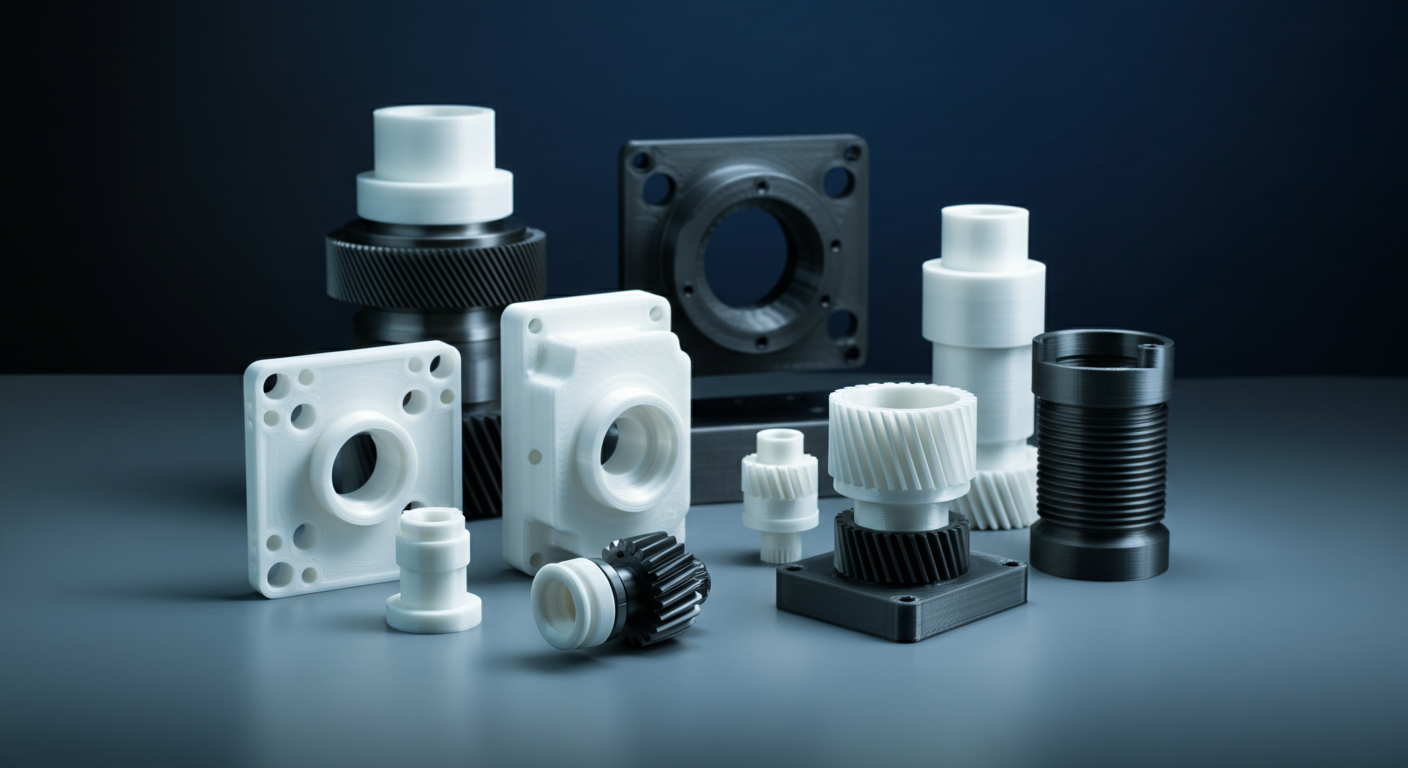
Modern engineering-grade filaments and printing techniques have closed the gap between printed parts and traditionally manufactured ones. Materials like PETG, ASA, nylon, and carbon-fiber-reinforced composites deliver mechanical properties that meet or exceed what many applications demand. When you combine the right material with optimised print settings — proper layer adhesion, appropriate infill patterns, and correct orientation — the result is a part that performs reliably in the field.
The question is no longer whether 3D printed parts can be used in production. It’s whether your specific application benefits from making the switch.
When Does 3D Printing Beat Traditional Manufacturing?
Not every part should be 3D printed. Injection moulding still wins at volumes of tens of thousands. CNC machining remains unmatched for tight-tolerance metal components. But there’s a surprisingly large middle ground where 3D printing offers clear advantages.
Consider these scenarios where businesses are already making the switch:
- Low-to-medium volume runs (10 to 2,000 pieces) where tooling costs for injection moulding can’t be justified
- Complex geometries that would require multiple CNC setups, assemblies, or simply can’t be machined at all
- Frequent design iterations where the product evolves and locking into a fixed mould is a liability
The real insight is economic. Traditional manufacturing front-loads costs into tooling and setup. You pay thousands of euros before a single production part exists. With 3D printing, the cost per part is nearly constant regardless of design changes. For a business launching a new product, testing a market, or serving niche customers, that flexibility translates directly into reduced financial risk.
Material Selection: The Key Decision
Choosing the right material is where end-use 3D printing succeeds or fails. A part printed in basic PLA might work fine on a trade show model, but it will warp, degrade, or crack under real-world conditions. End-use applications demand materials matched to their environment.
For outdoor or UV-exposed applications, ASA provides excellent weathering resistance — similar mechanical properties to ABS but without the degradation from sunlight. PETG offers a strong balance of chemical resistance, impact strength, and ease of printing, making it a workhorse material for industrial enclosures and housings. When higher temperatures or mechanical loads are involved, nylon and polycarbonate blends step in.
At 3Dennis, we guide businesses through material selection based on the actual operating conditions of the part. Temperature range, chemical exposure, mechanical stress, UV exposure — these factors determine the material, not the other way around. Getting this right means the difference between a part that lasts years and one that fails in weeks.
Real-World Applications Across Industries
The range of end-use applications is broader than most people expect. In manufacturing environments, companies use 3D printed cable routing systems, sensor housings, machine guards, and custom brackets that integrate directly into production lines. These aren’t temporary solutions — they’re permanent installations that outperform the generic off-the-shelf alternatives they replaced.
In the logistics sector, businesses print custom sorting trays, packaging inserts, and conveyor guides tailored to their specific product dimensions. A packaging insert that perfectly cradles an oddly shaped product eliminates damage during shipping — and it costs a fraction of what a custom thermoformed solution would run.
Healthcare and laboratory environments use printed enclosures for electronics, custom mounting solutions for sensors, and specialised holders for equipment. The ability to produce these in small quantities, quickly, and at reasonable cost has opened up possibilities that simply didn’t exist when the minimum order for custom plastic parts was 500 units.
Quality Assurance for Production Parts
One concern businesses rightly raise is consistency. If you’re putting 3D printed parts into a product or process, every part needs to meet specification. This is where professional 3D printing services differ fundamentally from hobbyist setups.
Production-grade printing involves calibrated machines, controlled environments, validated print profiles, and inspection processes. At 3Dennis, every batch goes through dimensional verification and visual inspection. Print parameters are locked down and documented, ensuring that part number 200 is identical to part number one.
For businesses transitioning from traditional manufacturing, this quality assurance framework is essential. You need to know that the parts arriving on your dock meet the same standard every time — and that there’s a documented process behind that consistency.
The Cost Equation: Total Cost of Ownership
When comparing 3D printing to traditional methods, unit price alone tells an incomplete story. The true comparison is total cost of ownership, which includes tooling, setup time, minimum order quantities, warehousing, and the cost of design changes.
A CNC-machined bracket might cost €8 per unit at a quantity of 500 — but that quote assumes you need all 500 at once, you’ve paid for the programming setup, and any design change means starting over. The same bracket, 3D printed, might cost €12 per unit — but you can order 50 at a time, change the design between batches at no extra cost, and carry zero inventory because lead times are measured in days rather than weeks.
For many businesses, especially those with evolving products or variable demand, the slightly higher per-unit cost of 3D printing results in significantly lower total cost when everything is factored in.
Getting Started with End-Use 3D Printing
The transition doesn’t need to be dramatic. Most businesses start by identifying one or two components where 3D printing offers a clear advantage — perhaps a part with long lead times from the current supplier, a component with frequent design changes, or a low-volume custom piece that’s disproportionately expensive to source traditionally.
From there, it’s a matter of validating the printed alternative: does it meet mechanical requirements, does it fit properly, does it hold up over time? Once that first part proves itself in the field, the conversation naturally expands to other components.
At 3Dennis, we work with businesses at every stage of this journey. Whether you’re exploring your first end-use application or scaling up an existing one, our team helps with material selection, design optimisation, and reliable production. Explore our services to see how we can support your manufacturing needs, or get in touch to discuss your specific application.
Keep reading
Flexible 3D Printing with TPU: When Rubber Beats Plastic
Discover when flexible TPU prints are the right choice. From vibration dampeners to seals and protective covers: everything businesses and makers need to know about flexible 3D printing.
3D Printing Material Selection: A Practical Guide for Business Applications
Choosing the right 3D printing material for your business project. PLA, PETG, ASA, Nylon and more - when to use each material and why it matters for functional parts.
Digital Inventory: How 3D Printing Eliminates the Need for Physical Stock
Discover how businesses replace costly physical warehouses with digital 3D print files. Print parts on demand and cut storage costs dramatically.
Need help with your project?
Contact us for custom 3D prints or B2B services.